


I was eight years old when my parents woke me up to watch two men walk on the moon. I remember staring at those grainy black-and-white images on our television as if it were yesterday. I didn’t fully understand what I was witnessing, but I knew it was extraordinary. More than half a century later, I can still feel the wonder of that moment.
What I didn’t know then, and wouldn’t learn until much later, was how close the mission had come to being aborted before those first footsteps. A computer had begun sounding alarms as the astronauts approached the lunar surface. The men aboard the spacecraft were running out of time, and the people responsible for bringing them home faced a decision that could change history.
But back on Earth, a young mother and her colleagues were helping keep the mission alive. And years earlier, her little daughter had helped teach her something important about human nature.
Something was terribly wrong
On July 20, 1969, Neil Armstrong and Buzz Aldrin were descending toward the moon’s surface aboard a spacecraft called Eagle. More than 200,000 miles from Earth, they were attempting something no human being had ever accomplished.
Suddenly, an alarm sounded inside the lunar module.
“Program alarm,” Armstrong reported to Mission Control in Houston. The computer displayed an unfamiliar warning: 1202.
Back on Earth, NASA engineers scrambled to understand what was happening. The spacecraft’s guidance computer was overwhelmed, struggling to process more information than it could handle. The astronauts were descending toward an unfamiliar landscape with limited fuel. There was no time to reboot the computer, consult a manual, or call a repairman.
Another alarm sounded. Then another.
Mission Control faced an agonizing decision. Should they abandon the landing or trust a computer that appeared to be failing at the worst possible moment?
According to NASA’s account of the Apollo 11 computer alarms, the computer was actually doing something remarkable. It recognized an overload and protected the tasks essential to landing the spacecraft.
The answer would depend, in part, on the work of a young mathematician who had spent years imagining everything that could go wrong.
A young mother with an unusual job
In the early 1960s, a young woman with a mathematics degree was working at the Massachusetts Institute of Technology. She had originally planned to continue her education, but her husband’s studies and the needs of their young family meant she would work for a while.
She had little formal training in computer programming. Almost nobody did. The field was so new that programmers were inventing many of the rules as they went along.
Computers were enormous machines occupying entire rooms. They were expensive, temperamental, and far less powerful than the phone you carry in your pocket. Many engineers still regarded software as secondary to the hardware that made everything run.
But this young mathematician saw things differently.
She understood that a computer’s usefulness depended not merely on its ability to follow instructions, but on what happened when those instructions failed. What if an operator made a mistake? What if the machine received conflicting commands? What if something unexpected happened at the worst possible moment?
These were not academic questions. She was working on a project that would eventually send human beings farther from Earth than anyone had ever traveled. And some mistakes would be impossible to correct.
The little girl who made a big mistake
Like many working mothers, the young programmer sometimes brought her daughter to the laboratory. The little girl enjoyed watching the machines and pretending to be an astronaut.
One day, while playing with a flight simulator, she pressed a button that disrupted the simulated mission.
Her mother was fascinated.
The child had accidentally exposed a vulnerability. If a little girl could press the wrong button, what might happen when an astronaut, exhausted and under tremendous pressure, made a similar mistake?
The programmer raised the concern with her colleagues. She wanted the software to anticipate human errors and protect the mission from them. Not everyone agreed that such precautions were necessary. Astronauts, after all, were highly trained professionals who followed detailed procedures.
But she wasn’t convinced.
She understood something that experienced leaders, parents, and anyone who has ever made a serious mistake eventually discovers. Training, intelligence, and good intentions don’t make us infallible. They make us human beings who can still do something foolish at precisely the wrong moment.
The best systems, she believed, should account for that reality.
As MIT’s account of her pioneering work explains, her approach emphasized software that could detect problems, recover from errors, and continue performing essential functions.
Her daughter’s simulator mishap would prove especially significant during Apollo 8, when astronaut Jim Lovell made a similar mistake. The team had to develop a way to recover the mission’s navigation information. The incident reinforced the importance of anticipating human error.
The computer overload that later threatened Apollo 11 was a different problem, but the underlying philosophy was the same.
Rather than assuming everything would work perfectly, engineers had designed software capable of surviving imperfection. And on that July afternoon in 1969, their work was about to face its greatest test.
Twelve hundred and two
Inside Eagle, the astronauts had no idea why their computer was issuing warnings. They only knew they were running out of time.
The problem was an unexpected demand on the computer’s limited processing capacity. A radar-related configuration was making the machine do more work than intended. The computer was receiving too many tasks at once, threatening its ability to guide the spacecraft safely to the surface.
But instead of shutting down, the computer did something extraordinary. It recognized the overload, discarded less important tasks, and continued processing the instructions essential to landing the spacecraft. The software had been designed to establish priorities under pressure. Now it was doing exactly that.
In Houston, guidance officer Steve Bales and computer specialist Jack Garman helped determine that the alarms did not require an immediate abort. Mission Control permitted the astronauts to continue.
Armstrong guided Eagle toward a safer landing area, passing over a field of boulders as the remaining fuel dwindled. Then came the words the world had been waiting to hear.
“Houston, Tranquility Base here. The Eagle has landed.”
Human beings had reached the moon. I remember my siblings and I watching it all with my parents. Magical.
The world celebrated the astronauts, scientists, engineers, and the American space program. It was a magnificent achievement, the culmination of years of work by hundreds of thousands of people.
But relatively few people knew about the young mother who had spent years imagining everything that might go wrong.
The woman behind the computer
Her name was Margaret Hamilton.
She was a mathematician who became a pioneer of modern software engineering, eventually leading the team that developed the onboard flight software for NASA’s Apollo missions.
Her work helped establish principles of error detection, recovery, and priority scheduling that remain fundamental to computing today. And that little girl who had accidentally disrupted a simulated mission? Her name was Lauren.
In 2016, President Barack Obama awarded Hamilton the Presidential Medal of Freedom. By then, the world had finally begun recognizing the significance of her contributions.
Margaret Hamilton died on September 30, 2026, at the age of 90. The Washington Post recently celebrated her remarkable life and contributions in her obituary.
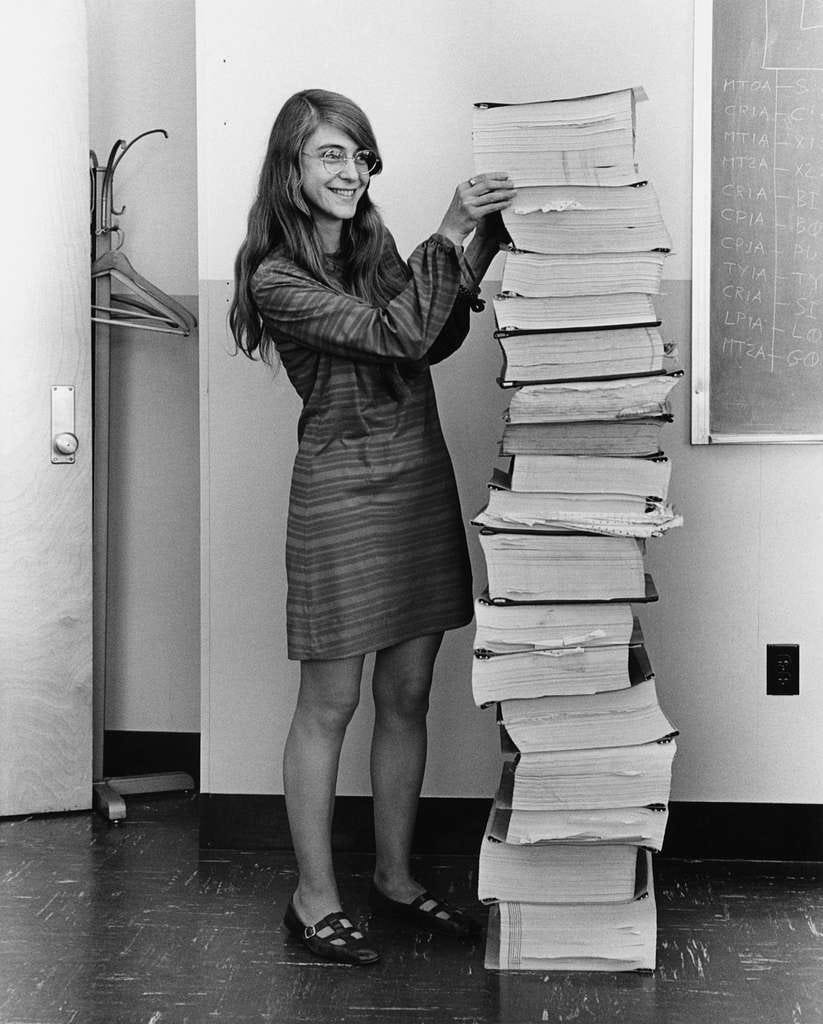
A famous photograph shows her standing beside a towering stack of printed computer code. The stack is taller than she is. It represents the software she and her colleagues developed for the Apollo program.
I find something profoundly moving about that photograph. A young woman working in a field that barely existed, raising a daughter, challenging assumptions, and imagining problems that others had overlooked.
As I think back to that eight-year-old boy watching the moonwalk on television, I’m struck by how much of history we never see. We celebrate the people who accomplish extraordinary things, often without knowing the countless others who made those achievements possible.
Perhaps that’s one of the great lessons of growing older. We come to appreciate the quiet contributions of people whose names we may never know, whose work matters enormously, and whose greatest achievements may happen far from the spotlight.
Sometimes the people who change history aren’t the ones who take the greatest risks. They’re the ones who quietly prepare for the risks nobody else has imagined.
And we can be grateful that Margaret Hamilton was one of them.