

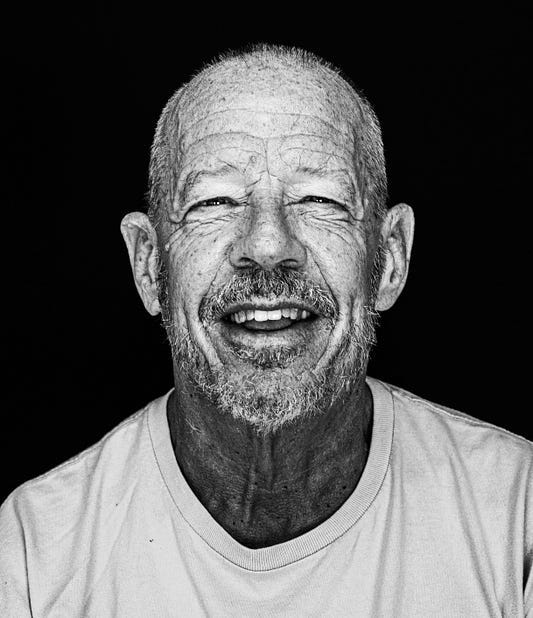
David Cooke’s portrait says what words can only try to explain. Sitting in front of the black backdrop in my garage studio, he did not pose as much as arrive. The shaved head, weathered face, gray beard, sun-marked skin, and easy smile all tell the truth of a man who has lived outside, inside, and through plenty.
In black and white, the same face becomes quieter, deeper, almost stripped down to spirit. You can see the lines, but they do not feel like age. They feel like evidence. This is a man who has stopped trying to hide from the road behind him.
He looks open, grounded, amused, and fully present. That is what I saw sitting with him. Not perfection. Not performance. Just David, comfortable in his own skin.
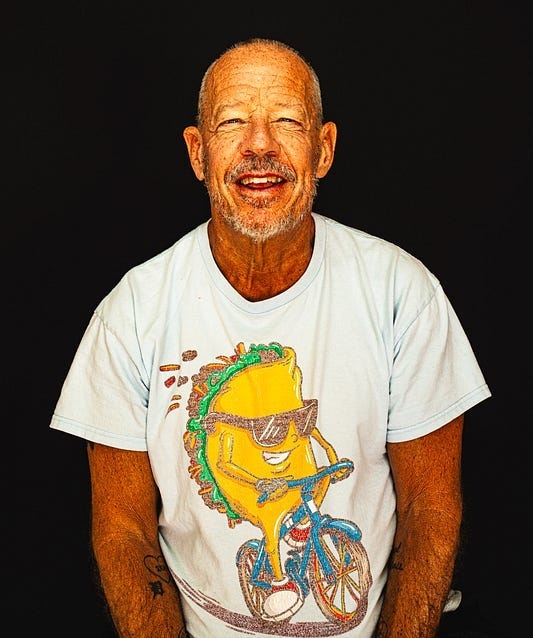
In the color version, there is warmth, playfulness, and mischief, helped along by the ridiculous joy of the cycling taco shirt.
At 69, he can look back and see his life in stages
He was born in 1957 in Grand Rapids, Michigan, and spent his formative years in the Detroit area. The first stage of his life was corporate. The second was consulting, sales, and business consulting. The third came after a family tragedy that deeply changed him. That experience led him to start a nonprofit called 100 Pedals and ride his bicycle across America for 100 consecutive days.
Now, David says he is living what he calls “the rogue life.”
That sounds rebellious, but not reckless. For David, the rogue life seems to mean living from the heart instead of the script. Less control. More trust.
Less chasing. More presence.
The turning point came in 2009
A serious addiction issue struck someone in his family. It rocked his world. Like many people who love someone in crisis, David first tried to react, fix, manage, and control what could not be controlled.
That path did not work.
Over time, he made a conscious shift. He intentionally moved from reacting to reflecting. He moved from trying to control life to learning how to accept it. Not passively. Not weakly. But with awareness.
That kind of acceptance is not giving up. It is growing up.
David has also lived a sober life for more than 25 years
He doesn’t wear it like a badge of attention-seeking honor. That matters because his presence does not feel accidental. It feels practiced. Sobriety, yoga, travel, loss, family pain, and faith have all shaped him into a man who seems less interested in escaping life and more interested in meeting it directly.
He does not preach about it. He lives it. That may be what makes it powerful.
When I asked David what he was most grateful for, he did not name one thing. He said he is grateful for the whole journey. All of it. Every stage. Every chapter. Every lesson.
That answer stayed with me because it did not sound polished. It sounded earned.
David does not claim to have no inner critic
When he looks in the mirror and takes stock of his life, he can still judge himself. He can still feel disappointed. But he has learned to distinguish between the smaller, self-critical mind and the larger part of himself that knows better.
He is a man of faith, but not a narrowly or rigidly religious one. His worldview feels universal. Open. Grounded. Human. He has a rare ability to meet people where they are — strangers, friends, whoever happens to be nearby.
I have known David for a little over 20 years, and I would call presence his superpower. He’s far more chill than when we first met. Taking a few runs through hell and back will do that.
The gift of presence
He can be present with people without needing to impress, fix, or perform for them. That was clear again when he came to my home studio, which is also my garage, so that I could make his portrait.
David is easy to be with, down to earth. No masks. No pretending.
In recent years, he has spent time in Bali and other parts of the world. He practices yoga and is certified to teach it. You can feel that in the way he carries himself.
The mind, body, breath, and presence are not theories to him. They show up in the way he speaks, the way he listens, and the way he moves through the room.
He describes himself as heart-led
You can feel it when you’re with him. His head, he says, can become too illogical. The heart knows who we are because the heart knows the soul.
“The soul knows who we really are.”
Everything outside of that belongs more to the ego, the self-critical mind, and the old story of not being enough.
David does not seem interested in chasing a destination anymore. That may be one of the gifts of aging well. At some point, life stops being only about getting somewhere. It becomes about being awake to where you are.
David enjoys sitting in local coffee shops and observing. He calls himself introverted, though he can turn on his extroversion when something matters to him.
Purpose lights him up. Meaning pulls him forward.
That, too, feels familiar
We have both changed over the last 30 years. We have both overthought life. We have both chased things. We have both learned, slowly and sometimes painfully, that control is not peace.
David’s story is not about having life figured out.
It is about learning to live without needing to.
That is radical acceptance. Not as a slogan. As a way of living.
Thanks for restacking this article if you found it helpful. I’m grateful when you invite your friends to join us.