

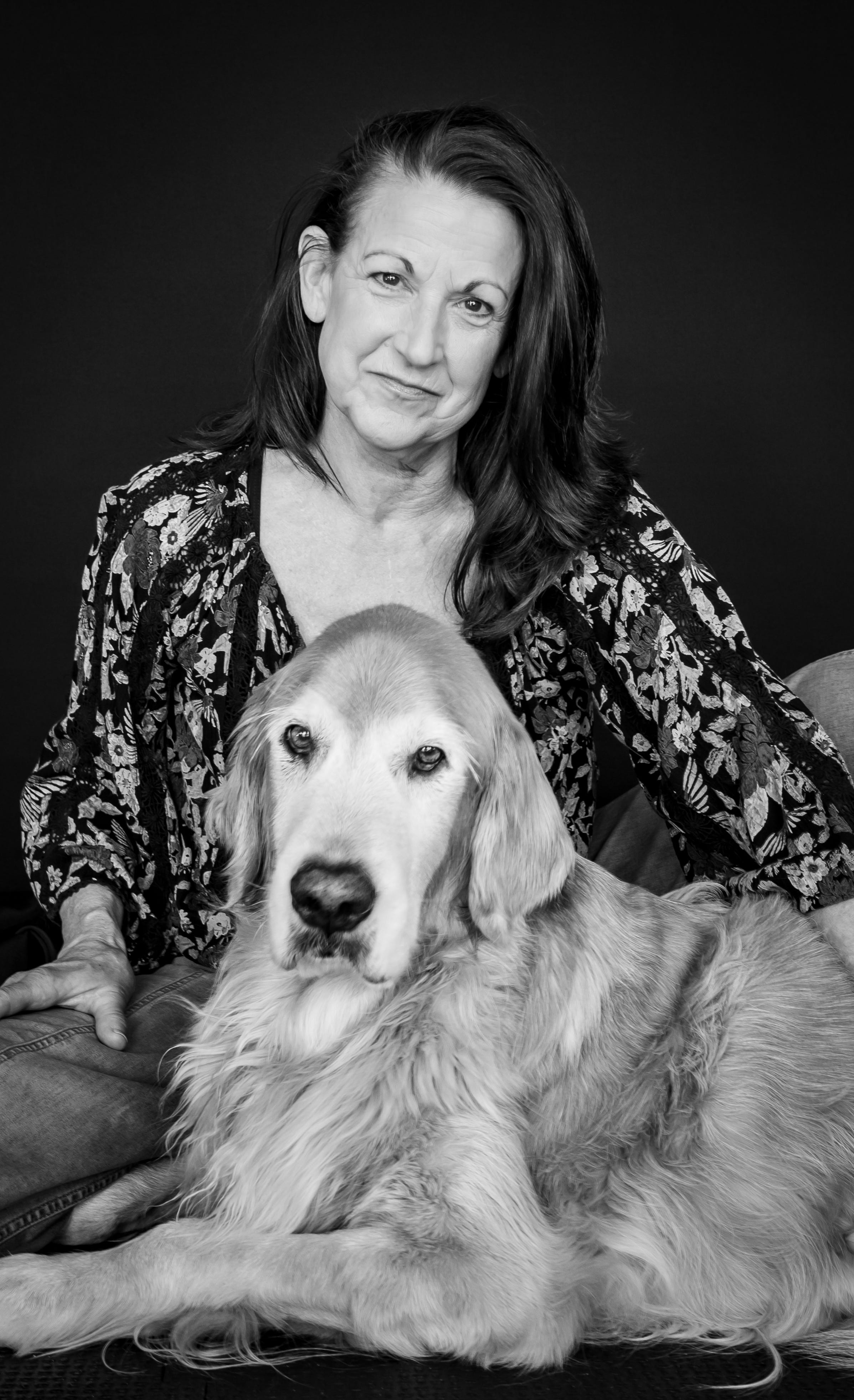
One of my intentions with Aging with Gratitude is to pour more of my energy into the arts that matter most to me: writing and photography.
But the other intention behind this work is to force myself out of my comfort zone, because at this stage of life it’s pretty easy to withdraw from the world’s mayhem and overlook the essential importance of human connection and stories.
I am naturally introverted and private. Walking up to someone and asking if I can photograph them, interview them, and ask intimate questions about their life does not necessarily come naturally to me. That is precisely why I am doing it.
The practice is not simply about taking better photographs or writing better stories. It is about extending myself into my community, working through whatever fear or hesitation shows up, meeting people where they are, and creating enough trust that they might allow me to see something real.
Sometimes those people live much closer than I realize.
Cindy Ayers lives less than a mile from our 1,400-square-foot home in North Scottsdale, Arizona. Our dogs know one another. Over the years, Cindy and my wife have become friends, and my wife has taken many Pilates sessions from her.
Still, it took me a while to work up the courage to ask Cindy if she would sit for a portrait.
She said yes.
We met in the three-car garage she transformed years ago into her Pilates studio. Cindy was a joy to photograph. We also photographed her two dogs, Russell and Asher, whose portraits you see accompanying this story.


Afterward, I asked Cindy another question.
Would she be willing to let me interview her for Aging with Gratitude?
Again, she said yes.
Ironically, although we live less than a mile apart, we interviewed by phone.
Be home before dark
Cindy grew up in the Chicago area and remembers her childhood as independent, free, and simple.
There was a park across the street. She remembers lying in the grass looking at puffy white clouds, exploring the woods, wandering through the neighborhood, and spending long days outside with friends.
She could disappear for most of the day.
At around 6 p.m., her Mother would blow a whistle.
Time for dinner.
Listening to Cindy describe it took me straight back to my own childhood in the 1960s and 1970s. Many of us grew up with a degree of freedom that seems almost unimaginable today.
The basic parental instruction was simple:
Be home before dark.
And off we went.
Cindy loved horses and decided early that she wanted one of her own. Wanting one and getting one, however, were two different things.
She started babysitting at eleven. At fifteen, she worked as a waitress. By sixteen, she had persuaded her parents to let her have a horse.
There was a catch.
Her parents made her sign a contract spelling out her responsibilities and the promises she would have to keep.
She signed it.
Looking back, Cindy told me that period of her life taught her something fundamental:
“I learned to depend on myself.”
That sentence would become more important later.
Building a life
Cindy eventually attended Northwestern University and later met Martin, an Australian who taught tennis professionally while on what she jokingly described as a “walkabout” through the Chicago area.
Friends introduced them.
They married and began building a life together.
For more than a decade, Cindy developed a successful career in marketing and communications. She worked with agencies and became a writer, designer, and producer.
After about fifteen years, she burned out.
So Cindy did what she had learned to do throughout her life. She changed direction.
She began building a career as a full-time fitness trainer, something that excited her enormously.
Then life changed the plan.
Their first son, Dylan, arrived in 2000.
Motherhood had not been part of Cindy’s immediate career strategy, but once it arrived, she committed herself to it with the same determination she had brought to everything else.
About three and a half years later, Quinn was born.
As Cindy described those years, they sounded almost idyllic.
She was raising two young boys while continuing to teach fitness part-time. Martin was tall, handsome, dynamic, and successful. He had launched his own hedge fund and had become a private pilot.
From the outside, it looked like the life people work decades to create.
Then, in 2006, everything changed.
The phone call no one is prepared for
Martin was flying his private airplane when it crashed.
He was killed.
Dylan was five.
Quinn was two.
I tried to imagine Cindy standing at the edge of that new reality, but there are experiences another person cannot truly imagine unless they have lived them.
The husband was gone.
The father was gone.
Cindy was suddenly a single Mother responsible for two young boys.
And there was more.
Martin’s business affairs, Cindy discovered, were a mess. Resolving what he had left behind required years of working with attorneys while simultaneously grieving, parenting, earning a living, and trying to create some form of stability for her children.
As I listened, my already considerable respect for Cindy rose to another level.
The woman speaking to me was calm and direct. She wasn’t telling me a heroic story about herself. She was describing what happened and what she did next.
She kept going.
Years later, on an anniversary of Martin’s death, Cindy’s father said something that changed how she understood her own story.
“We’re proud of you,” he told her.
Cindy was surprised.
“I didn’t have a choice,” she replied.
Her father disagreed.
“You did have a choice.”
He reminded her that she had chosen to raise two beautiful sons. She had chosen to carry the responsibilities of a single parent. She had chosen to rebuild her career, grow her fitness business, become part of her community, and continue finding her own path despite everything life had placed in front of her.
She had not merely survived.
She had chosen to thrive.
The infinite well
That distinction stayed with Cindy.
There were certainly moments when thriving didn’t feel inspirational.
She remembers driving home late one night after work and passing the Mayo Clinic in Scottsdale. Looking up at the hospital windows, she saw a room and had a strange thought.
How wonderful it would be to crawl into that bed and sleep.
Just sleep.
She was that exhausted.
Yet somehow, when she needed more energy, she found it.
Cindy described it as almost unconscious, an infinite well somewhere inside herself that seemed to provide what she needed when she needed it most.
Today, life continues to ask things of her.
She recently underwent knee surgery and has been working through her own rehabilitation while also caring for Asher, her aging dog, as he faces physical challenges of his own.
But Cindy is living a life she loves.
And perhaps that is what stayed with me most after we hung up.
Aging with gratitude does not mean pretending painful things didn’t happen. It doesn’t mean smiling through grief, denying exhaustion, or decorating tragedy with inspirational sayings.
It means recognizing that even when we cannot choose what happens to us, we often retain some ability to choose what happens next.
Cindy’s father helped her see that.
And Cindy helped remind me.
I began this project because I wanted a reason to pick up my camera, practice my writing, leave the safety of my own little world, and connect more deeply with the people around me.
I thought I was asking Cindy for a portrait and a story.
Instead, a neighbor less than a mile away gave me something more valuable.
She reminded me that courage often looks remarkably ordinary.
Sometimes it is raising two little boys when the person you planned to raise them with is suddenly gone.
Sometimes it is getting out of bed when you desperately want to sleep.
Sometimes it is rebuilding a career.
Sometimes it is rehabilitating a knee or caring for an old dog.
And sometimes it is simply walking across the neighborhood, knocking on someone’s door, and asking:
Would you let me hear your story?
Because when we do, we may discover that extraordinary lives have been unfolding quietly all around us.
And occasionally, if we’re fortunate, those stories change our own.
Thanks for leaving a comment and restacking this article if it helped you.
Great story about balance and perseverance. My big take away is the positive effect we can have on our adult children by a thoughtful comment of support and affirmation. Thank You Cliff!