

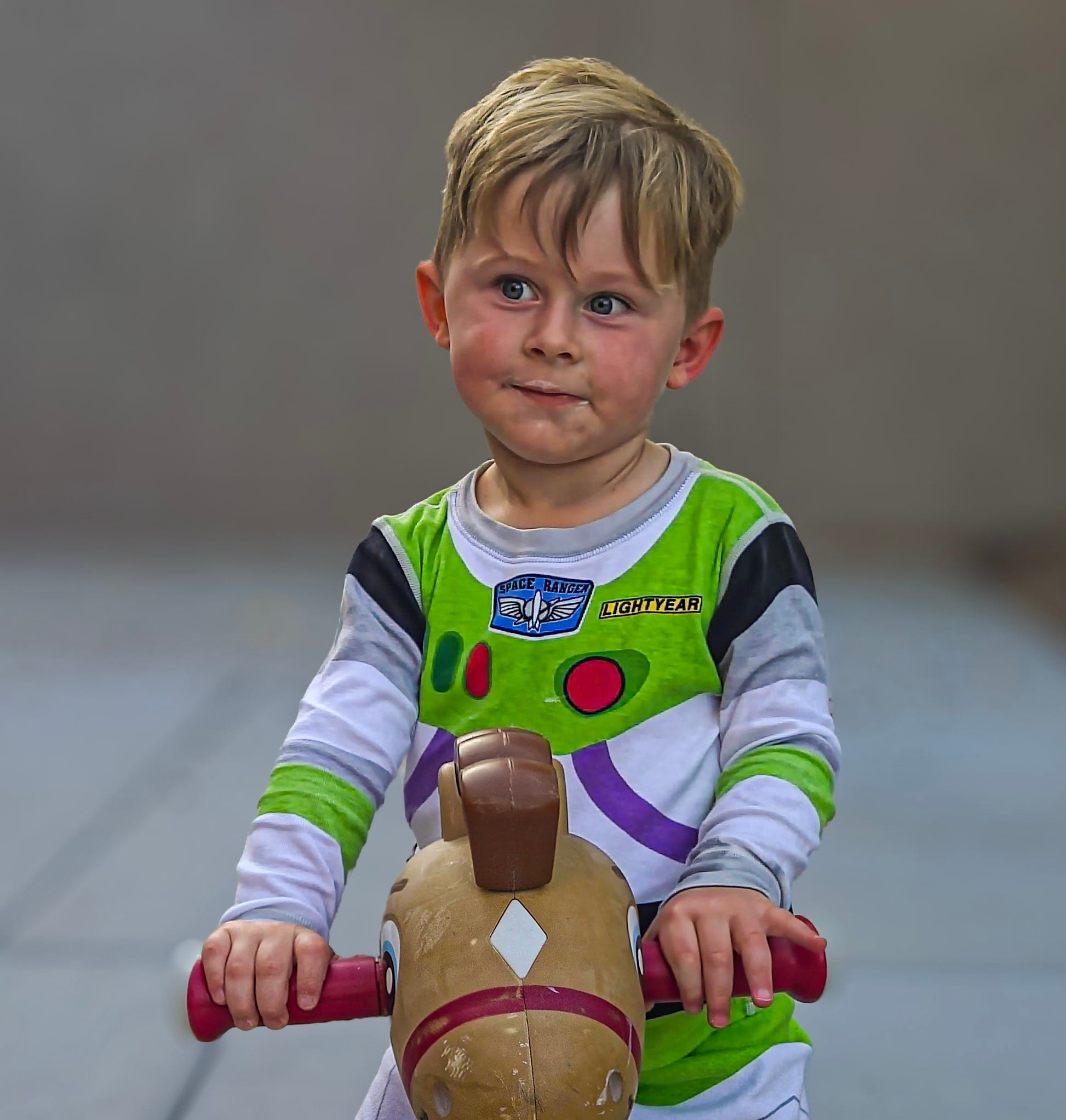
Look closely at Ford’s eyes in this photograph. He’s our oldest grandson, a little over three. He is wearing his Buzz Lightyear pajamas and sitting on a worn little rocking horse, but that is not where he is in his imagination.
He is Buzz Lightyear in this moment.
He’s also riding a magical horse across some distant world known only to him. I get to observe this, and in this moment, I am reminded of who we are.
The real us.
You can see the bliss in his face. He is completely absorbed in the adventure. All of us were like this early in life, until life happened, and we forgot.
Ford is not pretending halfway
He has entered the story with his whole being. He is not concerned about what happened yesterday or what might happen tomorrow. He is not wondering how he looks, whether anyone approves, or what he should accomplish next. He is fully alive in the only place life has ever happened, right here and right now.
When I look at him, I see what psychologists call a flow state. I also see something much older and more spiritual. Children seem to possess a natural ability to surrender to the moment before the world teaches them to worry, compare, hurry, perform, and protect themselves.
Children do not need to study presence because presence is still their natural way of being.
Children are presence, a gift
As adults, most of us gradually lose that state of presence. Our minds become crowded with responsibilities, ambitions, regrets, resentments, and fears. We replay conversations that ended years ago and prepare for problems that may never happen. We become so busy managing life that we stop experiencing it.
Then, as we grow older, many of us begin searching for peace.
The Tibetan Buddhist tradition of Dzogchen offers an interesting perspective on that search. Dzogchen is often translated as “Great Perfection” or “Great Completeness.” It teaches that beneath the restless movement of our thoughts, our basic awareness is already open, clear, and whole.
The self-perfected state does not mean that our personalities are flawless or that we no longer need to grow. It means that the peace we seek may not have to be created. It may have to be remembered.
That idea speaks to me as I age. I have spent much of my life trying to become something, build something, fix something, understand something, or overcome something. There is value in growth, effort, and self-examination, but there is also a time to stop struggling with life and learn how to rest within it.
Jesus offered a similar invitation when he said:
“Except ye be converted, and become as little children, ye shall not enter into the kingdom of heaven.” - Matthew 18:3
He was not telling us to become childish. He was pointing toward the qualities children often possess before experience hardens them: humility, trust, openness, wonder, and the ability to receive life without constantly attempting to control it.
Ford does not understand Dzogchen, and he does not need to. He does not need a meditation retreat, a spiritual teacher, or another book about living in the present. For now, he climbs onto his horse, becomes Buzz Lightyear, and disappears into a world of his own creation.
Watching him reminds me that I once lived that way too. We all did.
We’re the only animal that imagines
There was a time when a cardboard box could become a spaceship, a backyard could become an unexplored wilderness, and an afternoon could stretch on forever. We did not require life to be impressive before we allowed ourselves to enjoy it.
Wonder was available everywhere because we were present enough to notice it.
Aging can narrow our world when we focus only on what hurts, what has changed, and what we can no longer do. Those losses are real, and gratitude should never be used to deny them.
Yet growing older can also simplify us. We begin to understand that not every disagreement must be won, not every goal must be reached, and not every question must be answered. Some burdens can finally be set down.
The Psalmist described this peaceful surrender beautifully:
“I have calmed and quieted myself, like a weaned child with its mother.” - Psalm 131:2
That is the state I hope to inhabit as the years continue to pass. I do not expect constant happiness or freedom from grief. I hope for something quieter and deeper, a heart spacious enough to hold both sorrow and gratitude without being ruled by either.
Ford helps me remember how
When I am with him, I can put down the phone, stop measuring the usefulness of the moment, and enter his world for a while. I can laugh without needing a reason. I can recover my curiosity. I can be immensely grateful that I am still here to see the light in his eyes and feel his small hand reaching for mine.
Perhaps this is one of the greatest gifts our grandchildren offer us. They do more than continue the family story. They lead us back toward a part of ourselves we may have buried beneath the weight of adulthood.
Ford does not know he is teaching me anything. He is simply riding his magic horse.
I am the one remembering how to be alive.
Thanks for leaving a comment and restacking this article if it helped you.