

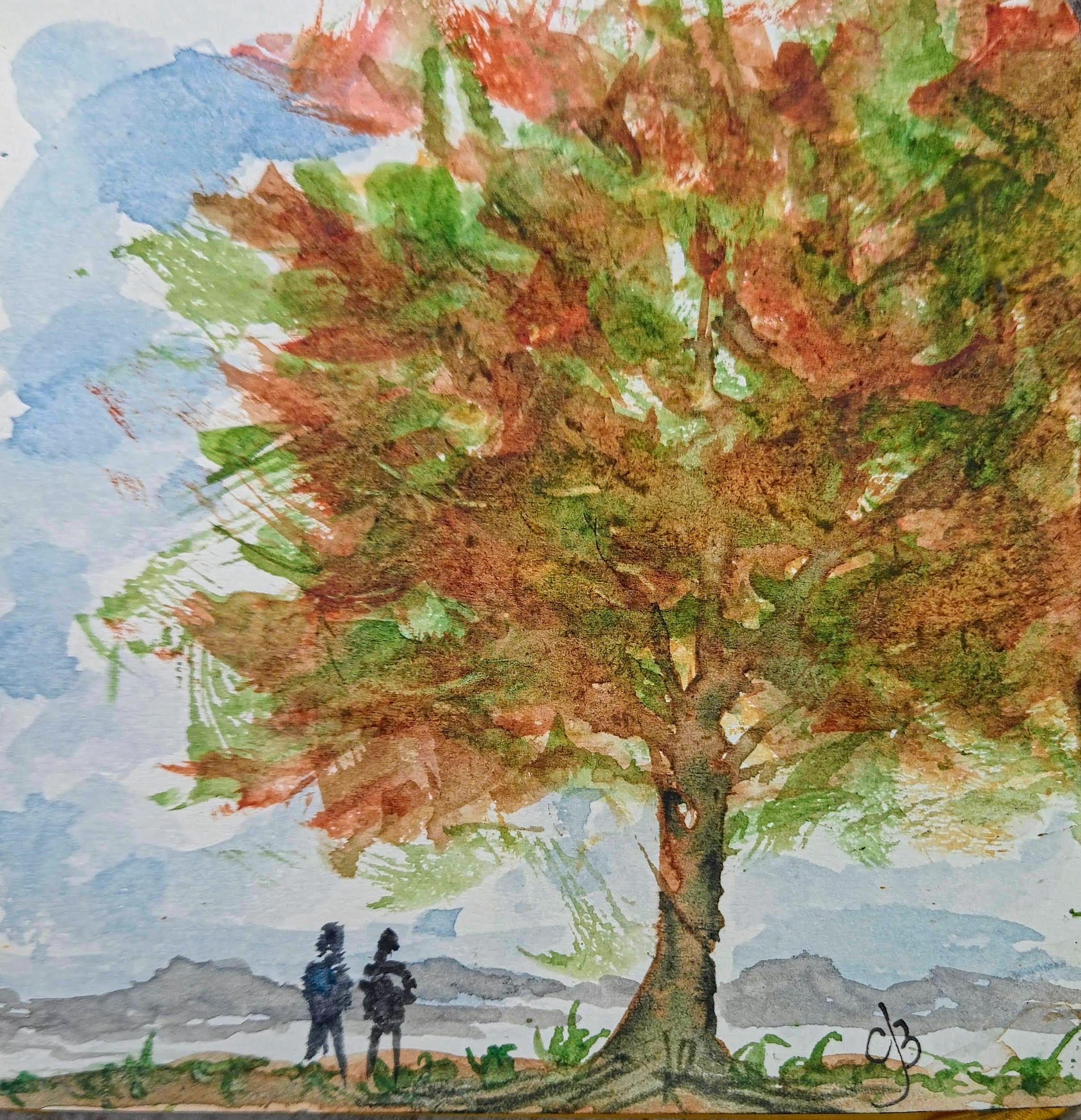
“Man, that’s an ugly painting,” I said to my brother, Greg, who had recently visited from out of town. “I can’t believe how ugly that is. Oh, well.”
As I walked out the back door, my wife, Janice, chuckled while Greg looked around the family room, confused.
“He does that a lot,” she said.
She’s right. I’ve been learning to sketch, draw, and paint since the pandemic locked us all down. Instead of losing my mind over losing my freedom, I fired up YouTube Premium and started watching art lessons. Lots of them.
Most of my paintings are ugly, and I’m learning to be okay with that. The one you see above might grow on me. It’s also true someone might love it. Crazier things have happened early in my art career.
I’m what’s known as an “outsider” artist
That means no art school or formal training beyond what I uncover by remaining as curious as a child. I’m committed to improving my painting. It’ll be one day at a time until I take my last breath.
I had no real self-image as an artist beyond my lifelong passion for writing and photography. But during the pandemic, something in me wanted to learn how to make art.
I’ve discovered that learning to accept an ugly painting is a lot like learning to accept an ugly part of ourselves. Both require us to keep looking when our first impulse is to turn away.
As you’ll soon see, learning various forms of art offers significant mental health benefits.
My need to create started early
I grew up hearing, “Children are to be seen, not heard.”
Well, screw that, I thought. I had a lot to say, and if I couldn’t say it, I’d write it. That partly explains the letter I sent to the editor of our local newspaper when I was thirteen. It was 1974, in the middle of an inflation shock that was hammering American families and businesses. My father’s business was struggling, our family’s sense of security was disappearing, and suddenly everything seemed too expensive.
I was pissed. Apparently, writing became one way to do something with that feeling. The same is true today. Painting does something similar for me now. What I’ve discovered through painting is what I’ve known through sports, writing, and photography most of my life: there is a place where the noise disappears.
We call it flow. Time goes away. The world outside the room keeps doing what it does, but for a while, I’m not arguing with it. My biggest obstacles to getting there aren’t a lack of talent or expensive art supplies. They’re procrastination and the little voice that says, “You suck too much to paint. Try something else.”
I’m learning not to listen to the nasty voice in my head
You know what I mean, if you’re human. The art of life is partly learning to love what we can’t stand. What we hate. The mistake. The disappointment. The person who drives us nuts. The parts of ourselves we wish were different.
For me, that involves a higher power, the God of my own humble, respectful understanding, and the slow practice of surrendering what I cannot control. Inner peace doesn’t mean the annoying people, painful circumstances, or ugly paintings disappear. It means they lose some of their power to own my attention.
Life can hand you something you never imagined carrying. But when I’m drawing or painting, those worldly things tend to disappear for a while. I’m looking at a line. A shadow. The shape of an ear. Too much water on the brush. Not enough pigment. Another mistake to work with instead of fight.
Let’s take a peek at the science of art
Some interesting science suggests that staying engaged with art as we age may do more than give us a temporary escape. I first came across a StudyFinds report about cultural engagement and aging. The underlying peer-reviewed study, published in the Journal of Epidemiology & Community Health, examined 1,899 older adults in England.
People who went more often to cinemas, museums, theaters, concerts, and other cultural activities tended to have a lower physiological age. The researchers were careful, however: the results showed an association, not proof that going to a museum makes you younger.
Then I found a different 2026 study that came even closer to what I’m doing at the kitchen table. Researchers at University College London looked at 3,556 adults and specifically included participatory arts such as painting, photography, crafting, singing, and dancing. Greater arts and cultural engagement was associated with slower biological aging on three newer epigenetic aging measures.
The relationships were generally stronger among people over forty, and on those measures the effects were comparable in size to those associated with physical activity. Take a look at the University College London study in Innovation in Aging if you want to learn more.
Nobody is saying an ugly watercolor is a substitute for exercise, sleep, good food, or medical care. Nor does this research prove that painting itself slows aging. But I find the connection fascinating. I ride my bicycle because I know my body needs movement. Maybe I pick up a pencil or paintbrush for a similar reason.
Creating forces me to pay attention. It makes me curious. It asks my hands, eyes, brain, and imagination to work together. Most importantly, it gets me out of my own head. Maybe that’s one of the secrets to aging well: Keep becoming a beginner. A beginner is allowed to make ugly paintings. In fact, a beginner is supposed to.
That’s how we learn
It’s how we grow regardless of our age. And maybe it’s how we make peace with the larger truth that none of us will ever become a finished piece of art. We’re all works in progress. So the ugly painting stays. I may laugh at it. I may walk past it and tell my brother how awful it is.
Someday, I may paint over it. But I made it. And that could be the point. Aging well may have less to do with becoming perfect and more to do with staying curious enough to keep creating, humble enough to keep learning, and peaceful enough to love the ugly parts along the way.
I suppose in the end, it’s about learning to be grateful for it all.